|
Discover
the hidden treasures of Drake Bay, Costa Rica with Tracie
"The Bug Lady" .

Home
Tour
Basics
Meet
the Bug Lady
Tales
from the Edge
Media
Reservations
Links

Facts about Drake Bay, Costa Rica
Travel To
Drake Bay
Drake Bay
Area Map
Hotel
Information
Tips for Travelers
Tours
Recommended
Reading



|
|
|
Masked
Tree Frogs are a common sight in Drake Bay,
and very often they are heard before they are
seen. 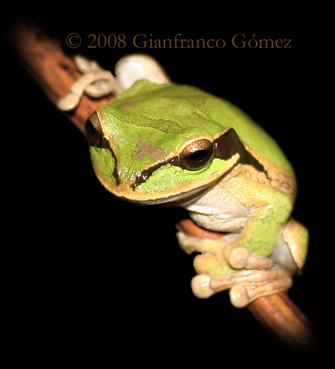
Their
raucous call fills the air throughout the rainy
season and during the dry season rains. They are
good sized tree frogs and adults measure between
40 to 78 millimeters.
Their common name comes from
the black patch that starts at the tip of the
snout and continues through the eye and the
eardrum, along the frog's face. This black
mask will enhance the frog's camouflage by
hiding the shape of the eye, which is what
many predators will use to detect their prey.
They can change their color and you may find
frogs with coloration ranging from light tan
to olive green.
|
|
When Masked Tree Frogs are breeding, males can
be found at nighttime calling from mud puddles
or swampy areas and also, quite reliably, at
La Paloma Lodge's swimming pool.

Their call
is a very loud "wrauk!" and they are normally
floating on the surface of the water while
calling. We have encountered males calling in
vegetation, although not as loudly as when in
water. As they call, their throat sac will
inflate into two large distinct bubbles, as can
be seen pictured on the right. If a female is
attracted to a calling male, she will join him
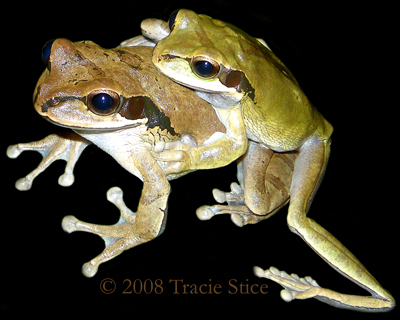
in his pool and they will unite in axillary
amplexus when they mate. This is when the male
climbs onto the female's back and grasps her
near the armpits, as seen below. |
|
 At
this point, the frogs will mate. The female
will lay up to 2000 eggs as the male
fertilizes them. The eggs float on the surface
of the water and will normally hatch within
the next 24 hours. At
this point, the frogs will mate. The female
will lay up to 2000 eggs as the male
fertilizes them. The eggs float on the surface
of the water and will normally hatch within
the next 24 hours.
Once the tadpoles hatch, they
will develop in their puddle until
metamorphosis is completed. This normally
takes between 60 and 80 days. Because they
develop in puddles that may dry out if there
are several days without rain, the tadpoles
are quite resistant to dehydration. They may
survive up to 24 hours out of the water.
During this time, they will hopefully get some
rain and their puddle will fill up again.
|
|
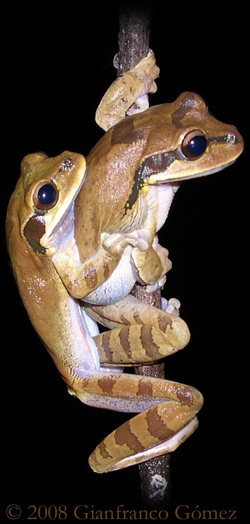 After
mating, couples will remain in amplexus for
some time and we regularly see amplectant
pairs moving through the vegetation. The pair
photographed here was on a vine about two
meters above a stream. As with most frogs,
females are larger than males and in this
species they seem to be quite responsive. After
mating, couples will remain in amplexus for
some time and we regularly see amplectant
pairs moving through the vegetation. The pair
photographed here was on a vine about two
meters above a stream. As with most frogs,
females are larger than males and in this
species they seem to be quite responsive.
Once
on a Night Tour, we encountered a large female
perched in a tree about three meters off the
ground. While explaining a little about the
Masked Tree Frog's natural history, I imitated
their call. Much to my chagrin, and our
tourists' amusement, she leapt from her perch
and landed directly on my chest!
Masked
Tree Frogs inhabit Humid Lowland Forests
throughout the Pacific and Caribbean regions
of Costa Rica. They are absent from the much
drier Guanacaste Province, in the northwest of
the country.
Masked
Tree Frogs are known to exist in Honduras,
Nicaragua, Costa Rica, Panama, Ecuador and
Colombia.
|
|
|
|
The Frog Files




     





|


 Alien
Earthlings
Alien
Earthlings  The Dark Side

 References: