|
Discover
the hidden treasures of Drake Bay, Costa Rica with Tracie
"The Bug Lady"

Home
Tour
Basics
Meet
the Bug Lady
Tales
from the Edge
Media
Reservations
Links

Facts about Drake Bay, Costa Rica
Travel To
Drake Bay
Drake Bay
Area Map
Hotel
Information
Tips for Travelers
Tours
Recommended
Reading



|
|
| |
|

|
| |
      |
|
|
| |
|
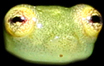
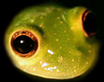
The Granular Glass Frog
|
|
Cochranella granulosa
|
| |
|
|
|

|
|
|
|
The Granular Glass Frog is found
throughout the humid lowlands of Honduras,
Nicaragua, Costa Rica, and Panama. The common
name is due to the skin's granular texture.
Adults may measure from 23 to 32 millimeters. 
Underneath,
the abdomen is transparent and the red ventral
vein as well as the intestines are visible.
The intestines are covered by a white
membrane. In some individuals the red liver
may also be visible.
They are normally found near
fast moving streams, where males call from the
upper surfaces of leaves. A male frog
typically protects a calling territory, and if
a rival male dares trespass, it gets ugly
fast! Males have been observed engaging in
sumo-style wrestling matches. They hang upside
down, on the edge of a leaf, by the tips of
their toes while clashing chest to chest and
grappling fiercely in an attempt to dislodge
each other. It may go on like this for over
two hours!
|
|
 Once his
territory is secure, the male will generally
call from high vegetation overhanging a moving
stream. He will usually move around and try
out a few different calling perches as the
evening progresses. Their call is a harsh
"creep-creep-creep" normally repeated two or
three times. When making their advertising
call, males will call over each other in an
attempt to drown out rival males. Because they
often call perched high above our heads,
seeing them is often difficult. Once his
territory is secure, the male will generally
call from high vegetation overhanging a moving
stream. He will usually move around and try
out a few different calling perches as the
evening progresses. Their call is a harsh
"creep-creep-creep" normally repeated two or
three times. When making their advertising
call, males will call over each other in an
attempt to drown out rival males. Because they
often call perched high above our heads,
seeing them is often difficult.
 If the male
successfully attracts a female, she will
approach him and they will mate. She will
normally lay her egg clutch several meters
above a stream, on the tips of leaves. Egg
clutches are made up of a thick, clear jelly
mass and may contain between 40 and 70 eggs.
The eggs will develop for 13 to 17 days and,
after hatching, it will take several months
for the tadpole to complete it's
metamorphosis. If the male
successfully attracts a female, she will
approach him and they will mate. She will
normally lay her egg clutch several meters
above a stream, on the tips of leaves. Egg
clutches are made up of a thick, clear jelly
mass and may contain between 40 and 70 eggs.
The eggs will develop for 13 to 17 days and,
after hatching, it will take several months
for the tadpole to complete it's
metamorphosis.
When the froglet is ready to
emerge, as seen below, it leaves the water
still sporting a long tadpole tail.
|
|
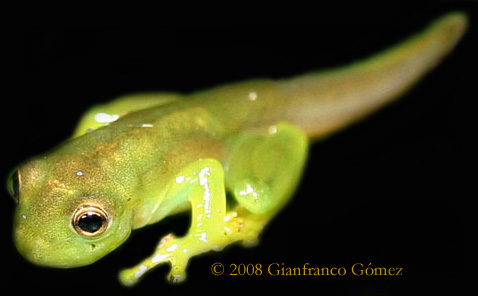
Upon reaching dry land,
it will remain fairly inactive for about five
days while absorbing it's tail. This provides
the young frog with nourishment and it will
have no need to feed until the process is
completed.
|
| |
|
References:
Kubicki, B. 2007 Costa Rica Glass
Frogs Editorial INBio
Leenders,
T. 2001 A Guide to Amphibians and
Reptiles of Costa Rica Zona Tropical
Savage, J. 2002 The Amphibians and
Reptiles of Costa Rica University
of Chicago Press
|
Click
below for more information about Gian's book

|
|
|
|
The Frog Files




     





|


 Alien
Earthlings
Alien
Earthlings  The Dark Side