|
Discover
the hidden treasures of Drake Bay, Costa Rica with Tracie
"The Bug Lady"

Home
Tour
Basics
Meet
the Bug Lady
Tales
from the Edge
Media
Reservations
Links

Facts about Drake Bay, Costa Rica
Travel To
Drake Bay
Drake Bay
Area Map
Hotel
Information
Tips for Travelers
Tours
Recommended
Reading



|
|
|

|
|
It
would truly be an understatement to say that
the Gliding Leaf Frog is a rare find in Drake
Bay. It was not collected in Costa Rica until
1967 and until recently was only thought to
exist in the southern Pacific region of the
country. They are, however, also found on the
southern Caribbean Slopes of Costa Rica.

In nearly
two decades of guiding the Night Tour, nearly
every night, we have only seen a handful Gliding
Leaf Frogs.
It was a misty night in late
July that we discovered our first Gliding Leaf
Frog. As we walked down the trail just past La
Paloma Lodge, the silhouette of a tree frog
perched on a leaf caught the corner of my eye.
The frog was off the trail on a leaf about two
meters off the ground.
We were having a great frog
night, and I nearly passed it by thinking it
was a Masked Tree Frog (Smilisca
phaeota) or a Gaudy Leaf Frog (Agalychnis
callidryas), both of which we had
already seen. I decided to have a look anyway
and approached the frog, convinced it was a
Gaudy Leaf Frog the closer I got. As I took it
in my hand, it surprised me by letting out a
deep, baritone "Grrrrt!". I could not believe
my eyes as I inspected the beautiful frog and
realized it was a Gliding Leaf Frog. Knowing
what we had, Tracie and I were by far the most
excited people in the group that night. The
frogs featured on this page are those two wild
individuals encountered in Drake Bay during
the Night Tour.
|
|
Gliding Leaf Frogs are the
largest members of their subfamily
(Phyllomedusinae) in Costa Rica, with adults
measuring between 67 and 95 millimeters. Frogs
on the Pacific side are slightly smaller than
on the Caribbean and also differ in that their
belly has an yellowish-orange coloration. They
are similar in appearance to the Gaudy Leaf
Frog (Agalychnis callidryas), to which
they are closely related. At first glance, one
striking difference is their huge, highly
webbed hands and feet as well as the
yellowish-orange coloration covering their
hands, feet, belly, and sides. 
Their eyes
also have a much darker maroon coloration than
the bright red eyes of the Gaudy Leaf Frog.
They are strictly canopy
dwellers, which explains why they are so
rarely encountered in their forest habitat.
Their common name is derived from a very
peculiar mode of locomotion they employ. When
these frogs are in a hurry to get down to the
ground or are fleeing from a predator, they
will freefall from their treetop perch. As
they fall, they will spread their extensively
webbed fingers and toes, breaking their fall.
Studies have shown that frogs released at a
height of 4.5 meters achieved nearly a 45
degree angle of descent and traveled up to 4
horizontal meters during their fall!
|
|
Gliding Tree Frogs are
nocturnal and normally only descend to ground
level during their mating season. At this
time, large congregations of frogs gather at
temporary ponds, flooded with rainwater.
Gatherings can number into the thousands and
huge numbers of frogs are literally draped
throughout the vegetation from 1.5 up to 10
meters above the water. This usually takes
place during or after a heavy rain. Breeding
starts at night, but will sometimes continue
until direct sunlight reaches the breeding
area, the next morning.
A few of our friends guiding in Corcovado
National Park have been lucky enough come
across these incredible scenes. To their
bewilderment, entire trees are swarming with
thousands of mating frogs, their branches
bending under their weight and their leaves
overwhelmed with egg masses.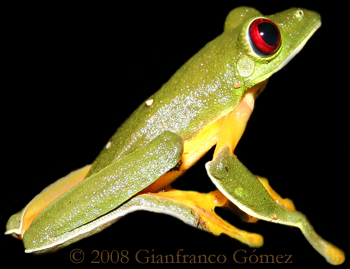
During these breeding frenzies, males
greatly outnumber females and will frequently
fight amongst themselves for access to them.
Once
daylight crashes the party, the frogs
disappear into the canopy just as quickly and
suddenly as they emerge. Just as we have a few
friends who have witnessed these amazing
reunions, we have other friends who have been
guiding in the area for decades and have never
seen a single Gliding Tree Frog.
The
egg masses are laid on the upper surface of
leaves and normally contain between 14 and 67
eggs. They will develop on the leaf for about
six days until the tadpoles wiggle out of the
egg mass and into the water below. This will
be their home for the next two to three months
until their metamorphosis is complete and the
little tree froglets leave the water to
continue their lives in the forest canopy.
Gliding Tree Frogs are only know to exist in
Costa Rica, Panama and Northwestern
Ecuador.
|
|
|
|
The Frog Files




     
v




|


 Alien
Earthlings
Alien
Earthlings  The Dark Side
