|
Discover
the hidden treasures of Drake Bay, Costa Rica with Tracie
"The Bug Lady" .

Home
Tour
Basics
Meet
the Bug Lady
Tales
from the Edge
Media
Reservations
Links

Facts about Drake Bay, Costa Rica
Travel To
Drake Bay
Drake Bay
Area Map
Hotel
Information
Tips for Travelers
Tours
Recommended
Reading


|
|
|
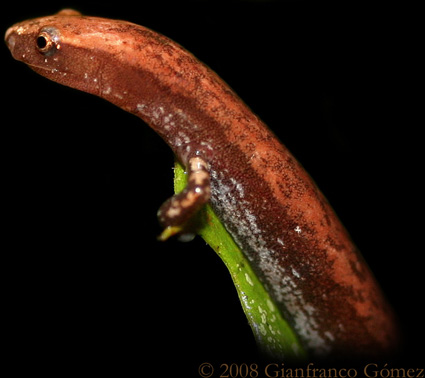
Allen's
Worm Salamander - Oedipina
alleni |
Although
rare to see, salamanders inhabit the
rainforest undergrowth of Costa Rica's Osa
Peninsula. They are very easily distinguished
from all other amphibians by their long
tail. Despite the very rich variety of
frog families represented in Costa Rica, there
is only one salamander family: Plethodontidae.
Plethodontidae is the world's largest
salamander family containing about 240
species. This is about 60 percent of all known
salamanders.
Fifty-three
species have been recorded in Costa Rica so
far and diversity is greatest in the
highlands. In January 2008 three species of
salamander new to science were discovered in
La Amistad International Park. La Amistad is
Costa Rica's largest National Park and is also
a UNESCO World Heritage Site. Four species of
salamander are known from the Osa Peninsula,
three of which are present in Drake Bay and
featured on this page.
|
|
Oedipina alleni and Oedipina
pacificensis, are know as worm
salamanders. Why they are called worm
salamanders is strikingly obvious when looking
at one. With their very narrow build, long
tail, tiny legs and feet, these salamanders
resemble earthworms at first glance. They also
quickly squirm for cover like little worms
when startled.

Allen's
Worm Salamander - Oedipina
alleni
Finding these exceptional creatures on
the Night Tour is always a very lucky
encounter. They spend most of their lives on
the forest floor underneath the leaf litter or
hiding under logs and rocks. Given their small
size and cryptic coloration, a run in with a
salamander is always an exciting and uncommon
event. It seems they are more easily
encountered moving about in the open during or
after a heavy rain.
Salamanders
are an extraordinary group. Worldwide, there
are many variations in their lifestyles,
reproductive habits, and development. Most
salamanders inhabit the Northern Hemisphere
with only a handful of species drifting south
of the Equator. On this page, we will
concentrate solely on Costa Rican salamanders.
All
Costa Rican salamanders are lungless and gas
exchange is believed to take place through
their very thin skin membrane, as well as
mucous membranes in the mouth and throat.
Also, Costa Rican Salamanders have interesting
receptors called nasolabial grooves. These
little grooves run from the salamander's
nostril to their upper lip and are believed to
pick up chemical cues from their surroundings.
A salamander may use this "sixth sense" in
order to find a mate, avoid predators, or
locate food.
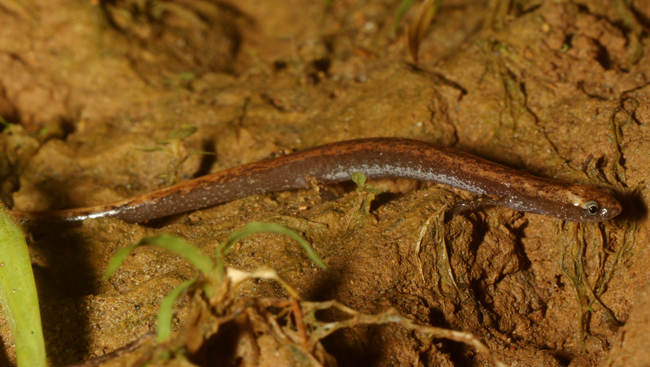
Allen's
Worm Salamander - Oedipina
alleni
|
|
Another weapon Costa Rican
Salamanders employ while hunting is their very
long projectile tongue. In some species the
tongue may measure up to 80 percent of the
salamander's body length and its tip is
designed for gripping, almost like a hand. It
only takes about ten milliseconds for
salamanders to shoot their tongue out and
snatch their unsuspecting prey!
When not in use, the tongue is rolled up and
stored in the same cavity where the
salamanders originally kept their lungs, which
they have lost through evolution. Worm
salamander's tiny legs and feet are another
feature believed to have been brought about by
evolution, to enhance their fossorial
lifestyle.
|
|
Oedipina alleni and Oedipina pacificensis,
are closely related. Adults normally measure
between 108 and 175 millimeters, with
Oedipina pacificensis being slightly
longer.
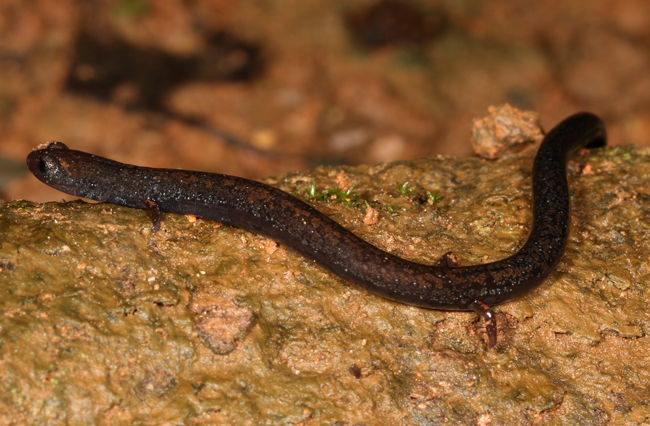
Pacific Worm
Salamander - Oedipina pacificensis
Salamanders are extremely
long lived and in Costa Rica some have lived
as long as 20 years. In one study group, males
did not even reach sexual maturity until they
were six years old and females at twelve years
of age! This is remarkable for such small,
delicate animals. Most species of lungless
salamanders are able to breed within six
months to three and a half years of hatching.
During breeding season, male
salamanders go through complex courtship
rituals to attract females. Male salamanders
don't call in an attempt to attract a mate, so
courtship is a proactive venture. This may
include pursuit of the female, ritualistic
dances, and caressing. Each species of
salamander has its own unique mating dance.
Male salamanders
also make a small incision on the female's
skin where they rub the females with their
"mental gland". This gland is located
underneath the male's chin and secretes
pheromones designed to entice her to mate.
Once she has been induced to mate, the male
lays his cone-shaped sperm packet, called a
spermatophore, on the ground and she
picks it up with her cloaca.
|
|

Pacific
Worm Salamander - Oedipina
pacificensis
Females can
store this sperm packet internally for up to
two months. When she decides to lay her eggs
they will be fertilized internally, as they
leave the cloaca. Generally, females lay
between 9 and 37 eggs individually in a moist
area on the ground. In some species the mother
curls around the eggs and guards her
offspring. Parental care has never been
recorded among the two Worm Salamanders
pictured here.
With every Costa Rican
salamander, all of the larval development
takes place inside the egg and the little
salamander that hatches out is a miniature
version of the adult. No metamorphosis takes
place after hatching. Costa Rican salamanders
are fully terrestrial and don't ever have an
aquatic phase.
|
|
But perhaps their most
incredible attribute is their ability for
regeneration. As with many lizards,
salamanders drop their tail when gripped by it
in order to escape a predator. Unlike lizards,
though, some salamanders regenerate their tail
complete with all its vertebrae!
Still
not fully understood by science, this amazing
skill is currently under heavy scrutiny by
researchers. If one day scientists are able to
solve this puzzle, could that mean a cure for
severe spinal injuries in humans?
Oedipina alleni and Oedipina pacificensis are
only known from southwestern Costa Rica and
adjoining western Panama.
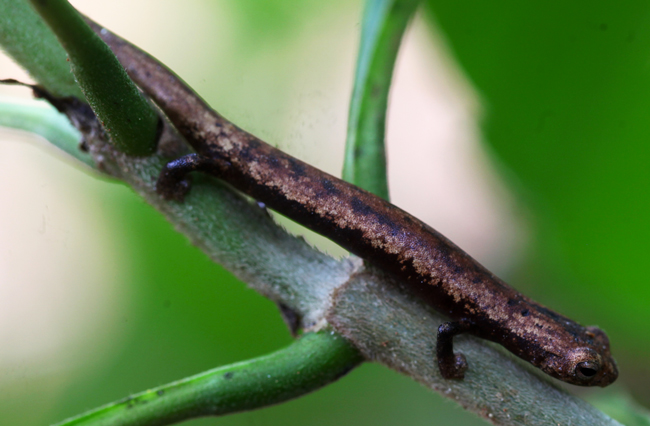
Camron Climbing Salamander
- Bolitoglossa lignicolor
The only other salamander species known from
Drake Bay is Camron Climbing Salamander (Bolitoglossa
lignicolor).
With 137 species belonging to this genus,
Bolitoglossa is the largest salamander
genus on earth. Every species in this genus
occurs in the neotropics. They are called
Webfoot Salamanders, due to their extensive
toe webbing. The toe webbing, along with their
prehensile tail, is an adaptation to climbing
and clinging
to wet leaves.clinging to wet leaves.
Like Worm
Salamanders, Webfoot Salamanders lay their eggs
in moist areas and go through direct development
in the egg, with no aquatic stage. Parental care
of the eggs has been observed with some species.
|
|
References:
Janzen, D. 1983
Costa Rican Natural History University
of Chicago Press
Leenders, T.
2001 A Guide to Amphibians and Reptiles
of Costa Rica Zona Tropical
Leenders, T.
2016 Amphibians of Costa Rica Zona
Tropical
Savage, J. 2002 The Amphibians and
Reptiles of Costa Rica University
of Chicago Press
Weldon
Owen Pty Limited 1993 Encyclopedia
of Animals Barnes & Nobles Books
|
Click
below for more information about Gian's book

|
|
|
|
The Frog Files




     





|


 Alien
Earthlings
Alien
Earthlings  The Dark Side
