|
Discover
the hidden treasures of Drake Bay, Costa Rica with Tracie
"The Bug Lady"

Home
Tour
Basics
Meet
the Bug Lady
Tales
from the Edge
Media
Reservations
Links

Facts about Drake Bay, Costa Rica
Travel To
Drake Bay
Drake Bay
Area Map
Hotel
Information
Tips for Travelers
Tours
Recommended
Reading



|
|
|
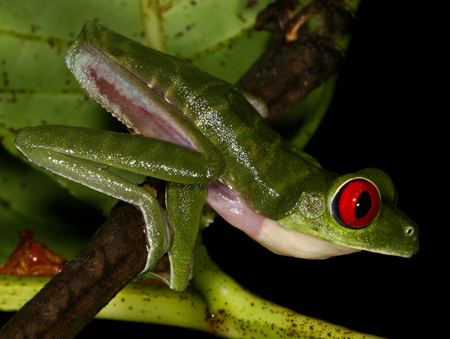
There is probably no better
ambassador for Costa Rica, and for Tropical
Rainforests in general, than the Gaudy Leaf
Frog. Their bold and vibrant color patterns
make them one of the most photographed frogs
in the world.
 Along with Toucans, Parrots,
Monkeys and Quetzals, these very attractive
amphibians have come to embody the beauty and
wonder awaiting discovery in the Costa Rican
Rainforest. There is hardly an item in any
souvenir store which is not decorated with its
image: t-shirts, beach towels, calendars,
hats, stuffed animals, shot glasses or any
other item imaginable. Along with Toucans, Parrots,
Monkeys and Quetzals, these very attractive
amphibians have come to embody the beauty and
wonder awaiting discovery in the Costa Rican
Rainforest. There is hardly an item in any
souvenir store which is not decorated with its
image: t-shirts, beach towels, calendars,
hats, stuffed animals, shot glasses or any
other item imaginable.
Yet, the moment you see this
frog in person, the reason it fascinates
observers and why it is such a sought after
model for photographers becomes strikingly
obvious. It truly has a charm all its own.
|
|
Gaudy
Leaf Frogs are primarily lowland frogs and can
be commonly found throughout the Caribbean
Lowlands and the humid lowlands of the Pacific
Slope from sea level to about 1000 meters in
elevation.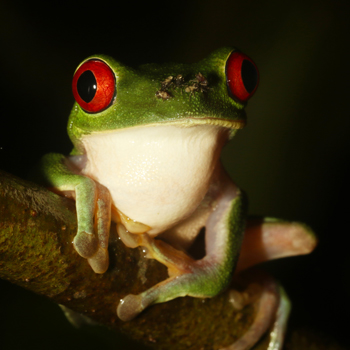 They are not found
in the drier parts of the Guanacaste Province,
but have recently been collected on the
southern most tip of the Nicoya Peninsula.
Their size ranges from 50 to 71 millimeters,
females being larger than males. They are not found
in the drier parts of the Guanacaste Province,
but have recently been collected on the
southern most tip of the Nicoya Peninsula.
Their size ranges from 50 to 71 millimeters,
females being larger than males.
There are two distinct,
geographically isolated, populations in Costa
Rica. Although they are still considered the
same species, frogs living on the Caribbean
side have much brighter coloration. These
individuals normally have bright orange hands
and feet as well as bright blue along their
sides. Their upper arms are normally either
bright blue or orange. The intensity of the
colors and their pattern make these Caribbean
frogs truly gaudy specimens.
|
|
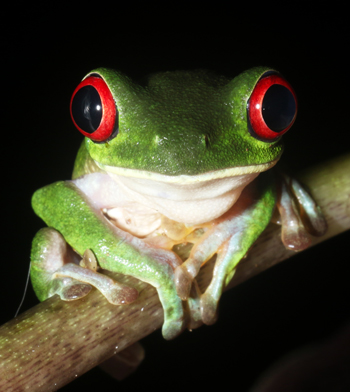
The coloration of Gaudy Leaf Frogs in Drake
Bay, and throughout the Pacific Slope, is a
bit muted. Their fingers and toes may have
greenish, cream or light orange coloration and
their sides are normally a much lighter blue
or brownish in color. 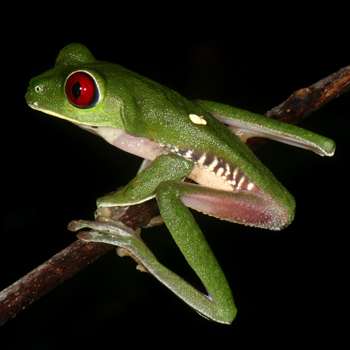 Still, they remain
a spectacle to behold and invariably bring a
gasp and a smile to everyone's face when
encountered on The Night Tour. All of the
frogs featured on this web page are wild
individuals photographed in Drake Bay. Still, they remain
a spectacle to behold and invariably bring a
gasp and a smile to everyone's face when
encountered on The Night Tour. All of the
frogs featured on this web page are wild
individuals photographed in Drake Bay.
Because of their arboreal and nocturnal
lifestyle, Gaudy Leaf Frogs are not so easily
encountered by travelers. During dry season,
as well as throughout the day, they all but
disappear into the forest canopy. Very little
is known about their activity during these
times. On the Pacific, because there is a
pronounced dry season, we only tend to see
them during the rainier months. Breeding
season normally begins in late May or early
June and this is when males descend closer to
ground level and embark on their quest to find
a mate.
Activity
usually peaks on rainy nights, sometimes
before or after a heavy rain. Generally males
will call in groups near a breeding site.
Calling males will try different perches,
facing different directions throughout the
night in an effort to improve their chances of
attracting a female. A gravid female will sit
and listen to the calling males until she
decides on one she likes.
|
|

Their advertising call is very
simple, usually a single
"chuck" or sometimes a double "chuck, chuck".
Although their call is so simple, a female
will decide on her mate based solely on his
call. Once she has decided on a mate she will
walk towards him in a straight line, passing
by other calling males on the way there.
On rare occasions, two males
will fight over a female, as is pictured on
the left. One night, while walking near La
Paloma Lodge, we came upon this incredible
battle scene. We watched in tense silence,
awaiting the outcome. During this match, the
two males wrestled for several minutes until
one was dislodged from the perch and retreated
unharmed. The larger female observed the
events develop from a branch a couple of feet
above the battleground.
|
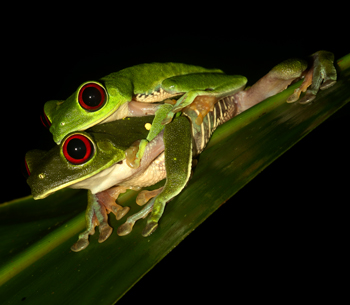 Once
the female finally reaches her chosen
male, she will turn around and he will
mount her in axillary amplexus. This
is when the male climbs onto the
female's back and grips her near the
armpits. In some cases, intrepid rival
males will attempt to dislodge the
already mounted male. Sometimes the
intruder will even lodge himself on
the female's back along with her
preferred mate and will also fertilize
the egg clutch! In these cases,
studies have shown that the two male's
DNA will fertilize different
individual eggs inside the egg clutch. Once
the female finally reaches her chosen
male, she will turn around and he will
mount her in axillary amplexus. This
is when the male climbs onto the
female's back and grips her near the
armpits. In some cases, intrepid rival
males will attempt to dislodge the
already mounted male. Sometimes the
intruder will even lodge himself on
the female's back along with her
preferred mate and will also fertilize
the egg clutch! In these cases,
studies have shown that the two male's
DNA will fertilize different
individual eggs inside the egg clutch.
|
|
|
Once
in amplexus, the female will descend to a body
of water, carrying her mate on her back, and
fill her bladder by absorbing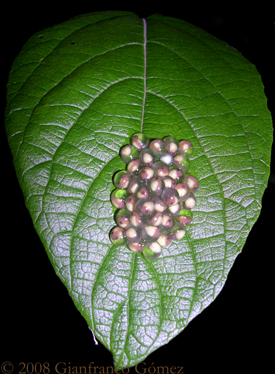
water
through her skin. She will then climb back into
the vegetation and pick a spot that is suitable
for her egg clutch. This is normally on the
upper or lower side of a leaf. Egg clutches may
contain anywhere from 11 to 104 eggs and will be
fertilized by the male as she lays them. After
the eggs are laid, she will empty her bladder on
them, making them swell as they absorb the
water. She may go through this process as many
as five times in a single night and lay up to
265 eggs.
The eggs are transparent and
the little embryos can be observed as they
grow. As they develop, they will take on a
darker brown color and frequently move around
inside their egg. They will finish their
development in about five to seven days.
|
|
Normally,
during a heavy rain, the little tadpoles will
wiggle free of the egg mass and will hopefully
find their way into a temporary pool where
they will complete their metamorphosis.

By
laying their eggs on leaves and completing
their tadpole stage in temporary pools,
rather
than rivers or streams, Gaudy Leaf Frogs
bypass the predators responsible for the
highest egg and tadpole mortality: fish.
Still, their eggs are preyed upon by Northern
Cat-eyed Snakes (Leptodeira
septentrionalis) and Yellow
Chunk-headed Snakes (Imantodes inornatus).
Northern Cat-eyed Snakes, which are frog
specialists, will also prey on adult frogs.
|
|
After
the tadpoles leave the egg mass and reach a
temporary pool they will complete
metamorphosis in about 80 days. Because their
development takes place in temporary pools,
tadpoles are quite resistant to dehydration
and may live up to 20 hours out of the water.
 This way, if their
puddle dries up, they may be able to survive
until the next heavy rain refills it. This way, if their
puddle dries up, they may be able to survive
until the next heavy rain refills it.
Once
the little frogs leave the water, it will take
them about a year to reach adult size. Very
little is know about the activities and
behavior of juvenile frogs.
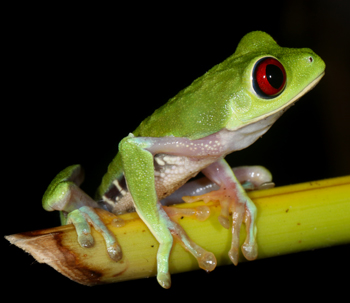
Gaudy
Leaf Frogs can change their skin color and
typically have their day time and night time
colors. They have a light green color during
the day and while they are at rest. After they
become active at night, their skin normally
turns a darker shade of green.
Like
most frogs, Gaudy Leaf Frogs posses skin
toxins. Frogs belonging to the Phyllomedusine
Subfamily, as Gaudy Leaf Frogs do, have a very
unique blend of toxins including two
substances not found on the skin of any other
amphibian on earth. Although they are not
nearly as irritating as many other Costa Rican
frogs, special care should always be taken
when handling them. There are some frog
species that should never be handled by anyone
besides trained professionals.
|
|
 A frog collector in
Costa Rica handled several Gaudy Leaf Frogs
and later smoked a cigarette without washing
his hands. The toxins passed on to his
cigarette and he then inhaled them. This
resulted in coughing fits and a general
discomfort that lasted for an entire day. When
handling any frog, it is always important to
wash your hands before and afterwards. Washing
them before will protect the frog from
absorbing any substances that you may have on
you hands. Washing them afterwards will
protect you from the toxins present on the
frog's skin. Even after washing your hands, it
is a good idea to refrain from touching your
mouth, eyes and nose. Small frogs should be
handled sparingly, since just your body heat
may be enough to make it overheat and kill it. A frog collector in
Costa Rica handled several Gaudy Leaf Frogs
and later smoked a cigarette without washing
his hands. The toxins passed on to his
cigarette and he then inhaled them. This
resulted in coughing fits and a general
discomfort that lasted for an entire day. When
handling any frog, it is always important to
wash your hands before and afterwards. Washing
them before will protect the frog from
absorbing any substances that you may have on
you hands. Washing them afterwards will
protect you from the toxins present on the
frog's skin. Even after washing your hands, it
is a good idea to refrain from touching your
mouth, eyes and nose. Small frogs should be
handled sparingly, since just your body heat
may be enough to make it overheat and kill it.
|
|
References:
Beletsky, L.
2005 Travellers' Wildlife Guides Costa
Rica Interlink Publishing
Kubicki, B. 2004 Leaf-frogs of
Costa Rica Editorial INBio
Leenders, T.
2001 A Guide to Amphibians and Reptiles
of Costa Rica Zona Tropical
Savage, J. 2002 The Amphibians and
Reptiles of Costa Rica University
of Chicago Press
|
Click below for more information
about Gian's book

|
|
|
|
The Frog Files




     





|


 Alien
Earthlings
Alien
Earthlings  The Dark Side