Costa Rica is home to
approximately 260 mammal species, including
marine mammals. This is roughly six percent of
the world's species. Seven of these are
endemic to Costa Rica and exist nowhere else
in the world.
Twenty-one
of our mammal species reach the southern limit
of their range in Costa Rica and twenty-seven
others reach their northern limits here. Despite
the rich diversity, mammal encounters are
relatively rare and usually ephemeral events.
As Ken Miyata and Adrian
Forsyth write in their wonderful publication Tropical Nature:
"A
naturalist's first visit to a tropical
rainforest can be both an exhilarating and
disappointing experience; the richness of the
vegetation may overwhelm the senses at first,
but sooner or later the apparent scarcity of
animal or insect life will begin to raise
questions."
Even
the richest rainforest may only have an
average of 14 mammal species. One reason
mammal diversity in Costa Rican forests may
at times seem dismal is that 120 of Costa
Rica's 260 mammals are bats.
Bats are solely nocturnal and
are usually only observed making speedy flybys
overhead or not observed at all. Even when
seen up close, many bats can only be
identified by experts and then only by
handling the animals.
Apart from bats, about three
fourth of the remaining Costa Rican mammals are
either partially or entirely nocturnal and
rarely seen by travelers. Only about thirty
Costa Rican mammals are active during the day
and even these are sometimes elusive and shy.
About
142 mammal species have been observed on the Osa
Peninsula. That amounts to about 63 percent of
all Costa Rican mammal species.
Common
mammal species we encounter on the Night
Tour include: Crab-eating Raccoons, Mexican
Mouse Opossums, Dark Four-eyed Opossums,
Spiny Rats, Vesper Rats, Pacas, Tamandua
Anteaters,
Three-toed Sloths, Two-toed Sloths, Common Opossums, Woolly
Opossums,
Kinkajous, Striped Hog-nosed Skunks,
Mexican Hairy Porcupines as well as several
Bat
species.
More
elusive, and incredibly lucky, mammal encounters
we have had on The Night Tour include: Central
American Silky Anteaters, Ocelots, Margay,
Pumas, and Tapirs. This page and the links on
the right feature several common nocturnal
mammal species represented in Drake Bay. All
animals featured are wild individuals and most
were photographed while on the Night Tour.
Paca -
Cuniculus paca
The
Paca is Costa Rica's largest rodent and is a
nocturnal denizen of Drake Bay. Regrettably,
this is not the case throughout the country.
Despite being rodents, their meat is highly
prized by hunters and is considered the best
bush meat in the country. They have been
hunted to the brink of extinction and are no
longer found in many areas. Over the last
few years we have seen this species making a
comeback in Drake Bay and we commonly see
them on the Night Tour.
Pacas are closely related to Agoutis but are
strictly nocturnal. They spend their days
sleeping in burrows, which have one main
entrance and one or more escape routes. The
Pacas stuff their escape routes with leaves. If
a predator enters the den, the Paca will burst
through the leaves covering their escape route
and flee to safety. Dens may be up 9 meters long
and are usually dug into the side of a bank.
In
areas where they are not persecuted, they are
often quite tame and have no fear of people. On
many occasions during the Night Tour we have had
Pacas walk onto the trail from the bushes and
head right towards the group! When startled,
they run a short distance into the vegetation
and stand perfectly still. Unfortunately, this
strategy does not work well against hunters with
dogs, lights, and guns.
Pacas mostly feed on seeds and fruit. They live
in monogamous pairs throughout the year, but
usually sleep in separate dens and forage
solitarily. Breeding takes place year round and
females normally give birth to a single
offspring. Pacas have been known to live up to
16 years in captivity and range from
southeastern Mexico to northern Paraguay.
Striped
Hog-nosed Skunk - Conepatus semistriatus
Perhaps
the most feared mammal to be found in Drake
Bay's rainforests is the Striped Hog-nosed
Skunk. An encounter with the wrong end of this
animal is an unforgettable event. Hog-nosed
Skunks, like other skunks, posses incredibly
potent scent glands near their anus. If
threatened they can spray an incredibly fowl
smelling liquid at a perceived threat for a
distance of about three meters.
The
substance burns if it makes contact with the
skin and may cause temporary blindness if it
reaches the eyes. Even if no contact is made,
the stench is so overpowering it immediately
causes teary eyes, runny nose, and nausea.
Hog-nosed Skunks are generally
very docile, peaceful animals, though, and do
not spray unless provoked. When angry, they will
generally loudly stomp their foot on the ground
as a warning.
Striped
Hog-nosed Skunks differ from their cousins by
their very long nose. They are often seen
sniffing along the ground and digging with their
long, sharp claws for insects, worms, and small
vertebrates that make their home in the ground.
They are also fond of different fruits and
coconuts.
In
South America, Hog-nosed Skunks are immune to
Pit Viper venom, and these snakes may also make
up part of Costa Rican skunk's diet.
Females normally give
birth to four or five kits and they may live
as long as six years. Striped Hog-nosed
Skunks range from Mexico to western Perúand eastern Brazil.
Although the Striped
Hog-nosed Skunk has a large geographical range,
little is known about its natural history. We
observed a pair mating in Drake Bay during the
month of August. You can watch the video below!
Vesper Rat -
Nyctomys sumichrasti
Vesper
Rats are perhaps the loveliest rats found
throughout Costa Rica's forests. They are
almost completely arboreal and move quickly
and gracefully through the vegetation. The
first toe on their feet is thumb-like and
highly adapted to gripping twigs as they
climb.
Because
they are nocturnal, we often encounter them on
The Night Tour. These little rodents tend to
freeze when caught in a flashlight's beam, as is
evident in the picture on the right.
These
rodents feed on seeds, fruits and insects and
range from southern Mexico to Panama. They
may live more than five years in captivity.
Vesper Rats very are similar in
appearance to Mexican Mouse Opossums, but are
much more commonly seen than the Mouse Opossum.
You can observe a
Vesper Rat feeding on fruit in the video below. We
encountered this individual during the Night Tour.
Mexican Mouse Opossum -
Marmosa
mexicana
Perhaps
the only opossum in Costa Rica that rivals
the Mexican Mouse Opossum's good looks is
the Central American
Woolly Opossum.
This tiny marsupial is simply adorable.
Although
similar to the Vesper Rat, Mexican Mouse
Opossums have some distinctive identifying
features. The easiest way to distinguish the two
is by their tail. The Vesper Rat has a hairy
tail, while the Mexican Mouse Opossum has a
naked, fully prehensile tail. Mouse Opossums
also have a dark mask around their eyes.
Mexican
Mouse Opossums are quite rare to see in the
wild, so our encounters are always prized
ones. Their frequent presence in the stomach
contents of Spectacled Owls (Pulsatrix
perspicillata)
at La Selva Biological Station suggests
their numbers are greater than previously
thought.
Adult Mexican Mouse Opossums are generally
solitary and seldom seen together. Little is
known about their social structure. Adults
measure between 26 and 39 centimeters with a
tail that is nearly as long as their body. They
generally nest in trees, underneath logs, in
dense bushes, tall grass, abandoned bird nests,
or underground burrows.
Their diet is mostly made
up of insects and fruit, but they may also eat
lizards, bird eggs and small rodents. We found
one individual inside our house feasting on a
banana and they have been discovered stowed
away in bunches of bananas as far away as New
York City!
Mexican Mouse Opossum
feeding on a scorpion (Tityus
sp.)
After mating, females are only pregnant for
about two weeks. They may give birth to up to 13
larvae. Unlike many other marsupials, Mexican
Mouse Opossums do not have pouches.
At
birth, newborns crawl to the mother's mammary
glands and attach themselves to one of the
nipples. Should they fall off, the young
opossums will cry out to their mother. She will
pull the lost baby toward her belly until it
reattaches to her teat. The young opossums
travel on the mother's back or tail once they
are old enough. If any of the young should die
the mother will eat their remains.
Mexican Mouse Opossums range from southern
Mexico to Panama.
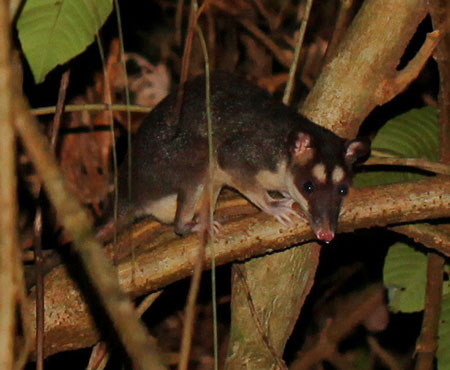
Dark Four-eyed
Opossum - Philander melanurus
The Dark Four-eyed
Opossum is one of our most commonly
encountered mammals on the tour. They are
called Four-eyed Opossums because of the
conspicuous white spots which are positioned
above each eye.
These
small marsupials frequent creeks, rivers and
swamps where they feed on frogs and freshwater
shrimp.
Other food items preferred by Four-eyed Opossums
may include lizards, bird eggs, fruit, nuts and
nectar.
Female Dark Four-eyed Opossums have a well
developed pouch where they carry their young for
about two and a half months.
Litters may number between two and seven larvae.
After the young opossums emerge from the pouch,
they will remain in a nest created by their
mother and continue nursing for another two
weeks.
Four-eyed Opossums reach sexual maturity at
seven months of age and usually only live for
about two years. Their range extends from
southern Mexico to Paraguay and northern
Argentina.
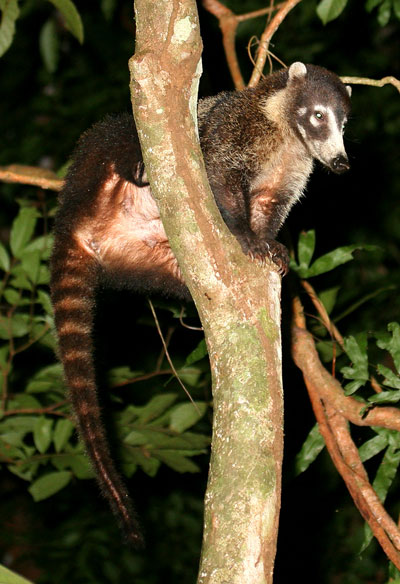
White-nosed Coati -
Nasua narica
Coatis
are some of Costa Rica's most frequently
observed mammals. Large groups, of up to 40
individuals, may be observed making
their way through the forest. Although they
are active during the day, we often
see lone males at fruiting Malay Apple,
Mango, and Breadfruit trees during The Night
Tour.A
Packs are made up of females and
immature individuals. Male Coatis are solitary
and are only allowed near the pack during their
breeding season. At this time, the male is
accepted by the females and will mate with each
member of the group.
Soon afterwards he will be
expelled from the group, possibly because males
are known to kill the newborns.
Pregnant females will break away
from the pack about three to four weeks before
giving birth. They usually make a leafy nest in
a palm tree or a tree crevice.
Females give birth to two to six
young and they will remain in the nest until
they are about four weeks old. Once they reach
about six weeks of age, the pups and their
mother will rejoin the pack.
We encountered the pregnant
female pictured above several nights on the
Night Tour as she prepared her nest in a tree.
Coatis
are omnivores and have a varied diet consisting
of insects, frogs, lizards, small vertebrates,
crabs, and fruit.
Their
range spans from the southern United States,
through Mexico, Central America and into western
Colombia and Ecuador. Life expectancy for Coatis
is about 14 years.
Crab-eating
Raccoon - Procyon cancrivorus
There are
two species of Raccoon in Costa Rica, but only
the Crab-eating Raccoon makes its home in Drake
Bay.
Both
Raccoon species look very similar and are
difficult to distinguish from a distance. The
Crab-eating Raccoon is larger than the
Northern Raccoon.
Crab-eating
Raccoons differ from Northern Raccoons because
the fur on their necks points towards the head,
instead of towards the tail like the fur on rest
of the animal's back.
Also, the
bands on their tails tend to be orange instead
of white, their feet are dark, and they tend not
to have under fur.
The
word Raccoon is derived from the North
American indigenous word "arakun" meaning scratching hands.
They are very
good climbers, but often forage on the ground.
They feed on crabs, mollusks, fish, frogs, small
vertebrates, insects, fruit and other food they
may scavenge.
Raccoons are
mainly solitary and nocturnal, but they are
sometimes active during the day.
Little is
known about the natural history of Crab-eating
Raccoons. We often observe this species on the
tour and we have also captured their behavior on
our camera traps. Crab-eating Raccoons often
visit fruiting trees. They are typically
solitary, but females can be seen with their
kits from December to February and from April to
June.
Raccoons use
their incredibly sensitive hands to detect
crustaceans underwater and under rocks. We have
often capture them on our camera trap as they
forage in our creek. You can observe this unique
behavior in the videos below!
Western Andean
Long-nosed Armadillo - Dasypus
fenestratus
There are two species of
armadillo in Drake Bay: the Northern
Naked-tailed Armadillo (Cabassous
centralis)
and the Western Andean Long-nosed Armadillo (Dasypus fenestratus).The latter is pictured here.
The Mexican Long-nosed Armadillo (Dasypus
mexicanus) is also present in northern
Costa Rica.
Western Andean long-nosed Armadillos can be
encountered in Drake Bay, although they are
elusive.They can be active at night or
during the day and usually forage slowly, with
their snout pressed right to the ground.Their
keen sense of smell aids them in detecting
prey items living in the leaf litter or
underground.In the tropics, Armadillos
feed mostly on ants and termites, as well as
fallen fruit.
These animals have very
poor eyesight and it is not uncommon for them
to walk right into a bewildered hiker’s feet.When startled,
Western Andean Long-nosed
Armadillos will often jump straight up into
the air and rush to safety.
The reproductive cycle
of Western Andean
Long-nosed Armadillos is nothing short of
amazing.After mating, females are able
to control the start of pregnancy by delaying
the implantation of the fertilized egg on the
uterus wall.
Although
this animal's gestation period only lasts about
2 months, female Armadillos have stunned
researchers by giving birth up to 32 months
after mating! When they do give birth, it is
exclusively to same sex identical quadruplets.
Hoffmann's
Two-toed Sloth - Choloepus
hoffmanni
In Costa Rica's lowland rainforests
Hoffmann's Two-toed Sloths, Choloepus
hoffmanni, are not so common to see.
These animals are mainly nocturnal and they
forage high in the canopy. They are active about
8 hours per day.
Although they are active for shorter periods
than Three-toed Sloths, Two-toed Sloths are more
mobile. They change trees frequently and are
rarely found in the same tree on consecutive
days.
Two-toed Sloths feed mainly on leaves but they
supplement their leafy diet with fruit, buds,
flowers, insects, and even bird eggs and small
vertebrates.
Two-toed Sloths have an incredibly long
gestation period, about 11.5 months. Baby sloths
cling to their mother during the first 6 months
of their lives, never leaving her side.
Even after they are weaned, young sloths may
remain close to their mother for up to two
years.They have been known
to live up to 32 years in captivity.
A
close inspection of the Two-toed Sloths in the
two photographs featured here will reveal a
distinctive green tint on the fur. Sloths have
slits on each one of their hairs that serve as
compartments where algae grows.
It
has long been thought that the green tint
afforded by the algae helps sloths better blend
into their canopy habitat. This theory makes
sense; after all having a green tint should help
canopy dwelling sloths conceal themselves in the
treetops.
Recently, though, researchers have proposed that
perhaps the algae is providing sloths with an
added benefit.
Scientists the sloths are feeding on the algae,
which provides sloths with easily accessible and
easily digestible energy.
The moths, which can be observed on the photo on
the left, play a role in this as well. It
appears that the amount of algae growing on the
fur is directly correlated to the number of
moths living on the sloth. The algae thrives on
the feces and decaying remains of the moths, so
the bigger the moth population, the more the
algae grows.
This leads researchers to think that the
Sloth's peculiar habit of coming down to the
ground to urinate and defecate could be linked
to this chain.
When the sloth defecates on the ground,
moths and beetles living on the sloth crawl down
and lay their eggs on the feces. The larvae
develop there and eventually fly back into the
treetops as adults in search for another Sloth
host.
The Sloths put themselves at considerable
risk by travelling all the way down to the
ground to defecate, but in doing so they provide
these insects with a suitable place to lay their
eggs and a great place for their larvae to
develop.
The insects insure the propagation of the
algae on the Sloth's fur and the algae provides
the Sloth with an important nutritional
supplement. The complicated relationship between
these completely different creatures is so
intertwined that Sloth Moths have evolved to
live exclusively in the fur of Sloths and do not
exist anywhere else in nature.
Mexican Hairy
Porcupine - Coendou mexicanus
The Mexican Hairy Porcupine is one of the
most elusive mammals in Drake Bay. So much so,
that it is not listed as being on the Osa
Peninsula in many of the guide books. It took us
many years before we saw our first one and they
are always a rare find around here.
They tend to be nocturnal and solitary and
very little is known about their natural
history.
Technically Porcupines are rodents and
they are the only rodents in Costa Rica to have
a prehensile tail. Porcupine's tails are
different from any other new world mammal in
that the gripping pad is located on top of the
tail, rather than on the bottom.
When they grip with their tail it curls
upward, as can be observed in the photograph
featured here.
The Porcupine's quills are this animals
most prominent and distinguishing feature.
Although Porcupines cannot throw their
quills, the quills do provide Porcupines with
protection from predators by breaking off very
easily and lodging into a would be
predator's skin.
Each quill has a very sharp point and is
covered with tiny backward pointing scales. This
makes them very difficult to remove once they
are lodged in the skin.
It is thought that the yellow quills also
serve as aposematic coloration, warning colors,
to deter predators. Also, when Porcupines are
startled the quills stand vertically making them
look much larger than they actually are.
Despite their spiny armor, felines feed on
porcupines by flipping them onto their back
where they lack quills.
Mexican Hairy Porcupines feed mainly on
seeds, fruit, leaves, flowers and flower buds.
They enjoy Ficus spp., Cecropia spp., and
we often encounter them feeding on the fruit of
Cojoba arborea.
Below is a video that we recorded during a
Night Tour of a Mexican Hairy Porcupine feeding
on Guava fruit.
Watson's Climbing Rat - Tylomys
watsoni
Watson's Climbing Rat is a very large
arboreal rat which is endemic to Costa Rica and
Panama. It is known to live throughout Costa
Rica, except in the dry northwestern part of the
country, up to 3000 meters above sea level.
Although Watson's Climbing Rats have a
widespread range, they are rare to see in Drake
Bay. They are known to sometimes inhabit
buidings in areas surrounded by forest.
Not much is know about this rodent's
natural history, but they are known to feed on
just about anything including plant material,
lichen and bark. Apparently they have a strong
preference for chocolate and soap!
Due to their arboreal habits and
white-tipped tail, Watson's Climbing Rats are
sometimes mistaken for opossums.
Tomes’
Spiny Rat - Proechimys semispinosus
Tomes' Spiny
Rats are nocturnal and are most often observed
on dark nights. Studies have found that Tomes'
Spiny Rats are just as active on moonlit
nights, but they avoid open areas to evade
predators.
They
occupy an important place in the food chain,
so they do indeed have a wide range of
predators to worry about. A study carried
out in Corcovado National Park revealed that
one quarter of all puma scat and half of all
ocelot scat examined contained the remains
of Tomes' spiny rats. Another study from La
Selva Biological Station revealed that
Tomes' spiny rats are a favorite prey item
of bushmasters (Lachesis
stenophrys).
Bushmasters are the world's longest pit
vipers and are highly endangered throughout
their range.
When confronted
by a predator, Tomes' Spiny Rats have a
built-in escape mechanism. Their long tail is
designed with a weak point along the fifth
vertebra which easily breaks when gripped by a
predator. The tail does not grow back and as
many as 25% of adult rats have no tail. I have
known several people who have befriended
large, tailless Tome's spiny rats with
bananas, having confused them with baby
agoutis!
During
the day, Tomes' spiny rats sleep in
underground burrows. They do not dig their
own burrows, so they rely on natural
cavities or burrows dug out by other
animals. They may sleep on their own or with
several other rats. On two separate
occasions, I observed a Tomes' spiny rat
crawl into a burrow already occupied by a
smoky jungle frog (Leptodactylus
savagei). With a
maximum length of more than 14 centimeters,
the smoky jungle frog is Costa Rica's
largest frog species. They also spend their
days in burrows, but they seem like unlikely
roommates for a rat!
Tomes' spiny rats feed on fruit, seeds, fungi,
and other vegetable matter. They are
considered important seed dispersers. While
foraging, Tome's spiny rats often collect food
in their mouth then carry it to a safe place
to eat.
Central
American Silky Anteater - Cyclopes dorsalis
With
an average weight of 300 to 500 grams, silky
anteaters are the smallest of all anteaters.
They belong to the family Cyclopedidae which
is made up entirely of silky anteaters. The
silky anteater has long been considered a
single species ranging from southern Mexico to
Ecuador, Peru and Brazil in South America. A
recent study published in 2018, however,
suggests this species should be divided into 7
distinct species.
These tiny
creatures move silently through the treetops
in the darkness of the night. Silky anteaters
feed almost exclusively on ants, using their
enlarged front claws to tear into the nests.
Like tamanduas, they ingest fleeing ants using
their extraordinarily long tongue. The silky
anteater's small size, however, prevents them
from ripping into hard termite mounds. During
the day, silky anteaters curl up into a tight
ball and enter a deep sleep. Curling up tight
helps them conserve energy by preventing heat
dissipation. They also lower their metabolic
rate and enter a state of torpor.
Much mythology
surrounds these secretive and mystical
creatures. Legends echo in the forests that
silky anteaters supernaturally exist in
multiple dimensions. Natives of Costa Rica's
Talamanca region believe they only descend
from the heavens to announce an impending
death. Another widespread myth is that if
captured, silky anteaters inexplicably
disappear before daybreak. Silky anteaters are
also sacred in the traditions of the Bri Bri
tribe of southeastern Costa Rica. It is said
these delicate creatures guide the souls of
the dead into heaven.
Baird's Tapir - Tapirus
bairdii
Baird's
tapir is Costa Rica's largest land mammal.
While they are not very tall, standing just
under 120 centimeters, they are quite rotund.
Baird’s tapir can weigh in at a hefty 150 to
400 kilograms. Their range extends from
southeastern Mexico to northern Colombia and
Ecuador. They are highly endangered throughout
their range and it is estimated that only
5,500 individuals remain in the wild.
These gentle giants
feed mostly on leaves, stems, fruit, and
tree bark. Tapirs are shy,
mostly solitary animals. They can be active
day or night. They do not easily dissipate
heat so they spend the hottest hours of the
day in their preferred mud wallows. These are
the best sites to see tapirs during dry season
in Corcovado National Park. We have a mud
wallow on our property which has been
frequented by a breeding pair for several
years.
Although studies on their natural history are
scarce, male and female tapirs are thought to
form lasting bonds and breed year-round. Their
gestation is one of the longest of any mammal,
lasting up to 400 days. Tapir calves have a
spotted coat at birth, which enhances their
camouflage. The streaked coloration disappears
between 4 and 8 months after birth. Both
parents play a role in raising their calf and
young tapirs become independent in 1 to 2
years. They may live up to 25 years in the
wild and up to 35 in captivity.
In recent years, we have seen an increase in
Drake Bay's Baird's Tapir population. Here are
a few videos of some of our Tapir encounters!
Baird's Tapir
feeding at La Paloma Lodge
Enjoy our
individual mammal pages by following the links
located at top of the page on the right hand
side!
References:
Alonso-Mejia, A.
& Medellin R. 1992 "Marmosa
mexicana" The American Society of
Mammologists
Beletsky, L.
2005 Travellers' Wildlife Guides Costa
Rica Interlink Publishing
Emmons,
L. 1990 Neotropical Rainforest
Mammals University of Chicago Press
Fogden,
M. & P. 2001 Vida Silvestre de
los Parques Nacionales y Reservas de Costa
Rica Editorial Heliconia, Fundacion
Neotropica
Forsyth, A. & Miyata
K. 1984 Tropical Nature
Touchstone / Simon & Schuster
Henderson, C.
2002 Field Guide to the Wildlife of
Costa Rica University of Texas Press
Janzen, D. 1983
Costa Rican Natural History University
of Chicago Press


 Alien
Earthlings
Alien
Earthlings  The Dark Side






 Vesper
Rats are perhaps the loveliest rats found
throughout Costa Rica's forests. They are
almost completely arboreal and move quickly
and gracefully through the vegetation. The
first toe on their feet is thumb-like and
highly adapted to gripping twigs as they
climb.
Vesper
Rats are perhaps the loveliest rats found
throughout Costa Rica's forests. They are
almost completely arboreal and move quickly
and gracefully through the vegetation. The
first toe on their feet is thumb-like and
highly adapted to gripping twigs as they
climb. 

 These
small marsupials frequent creeks, rivers and
swamps where they feed on frogs and freshwater
shrimp.
These
small marsupials frequent creeks, rivers and
swamps where they feed on frogs and freshwater
shrimp.