|
Discover
the hidden treasures of Drake Bay, Costa Rica with Tracie
"The Bug Lady" .

Home
Tour
Basics
Meet
the Bug Lady
Tales
from the Edge
Media
Reservations
Links

Facts about Drake Bay, Costa Rica
Travel To
Drake Bay
Drake Bay
Area Map
Hotel
Information
Tips for Travelers
Tours
Recommended
Reading



|
|
|
|
|
|
|
|
      |
|
|
| |
|
The Dusty Glass Frog
|
|
Teratohyla
pulveratum
|
|
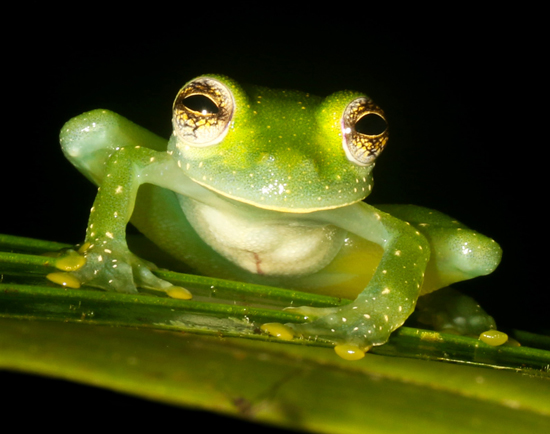
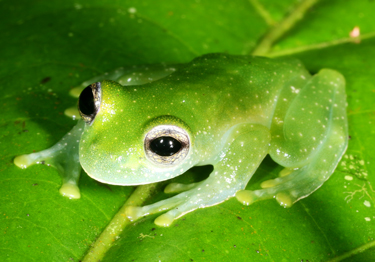
Shiny white dots
scattered throughout it's top side
give this lovely frog the appearance
of having been sprinkled with moon
dust, explaining it's common name.
Adults measure between 22 and 33
millimeters.
Viewed from beneath,
the Dusty Glass Frog is completely
transparent. It's heart, liver and
intestines are covered with a white
lining, but the red ventral vein is
visible as well as the frog's bluish
green bones. Interestingly, a gravid
female's unfertilized eggs can also be
seen through her transparent belly.
|

This
frog can be found from
sea level to 850
meters above sea level
on the Caribbean Slope
and in the Southern
Pacific regions of
Costa Rica. Adults
live and breed along
forested streams.
Males
generally frequent the
forest canopy and call
from perches three to
eight meters above
fast moving streams
and rivers, making
encounters a very rare
treat.
Groups of calling
males may include
anywhere from two to
five individuals, each
one defending it's own
territory.
|
|
| |
|
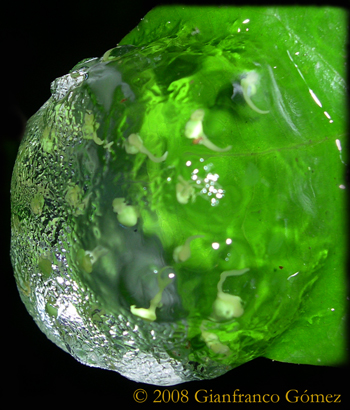 If a male is
successful in attracting a
female, they will mate and the
female will typically lay her
eggs on the upper surface of a
leaf overhanging the water. If a male is
successful in attracting a
female, they will mate and the
female will typically lay her
eggs on the upper surface of a
leaf overhanging the water.
Clutches
include about 50 eggs which
are housed in a thick, clear
jelly mass about the size of a
golf ball. The egg clutch
pictured here was photographed
in Drake Bay during the month
of August.
Unlike many
members of it's genus, Dusty
Glass Frog males do not appear
to partake in parental care.
The thick jelly mass
surrounding the eggs
apparently provides them with
some protection from
dehydration and
predation.
|
|
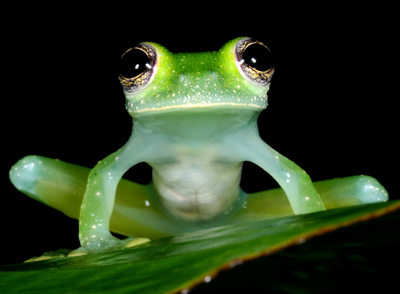 This
frog's tadpoles were
only described by
scientists in 2004,
here in Costa Rica. As
occurs with other
glass frogs, the
tadpoles of this
species have a red
coloration. This
frog's tadpoles were
only described by
scientists in 2004,
here in Costa Rica. As
occurs with other
glass frogs, the
tadpoles of this
species have a red
coloration.
Because their skin is
transparent, it is the
red blood in their
internal organs which
gives tadpoles their
color.
|
|
|
After
hatching, tadpoles generally
squirm from the egg clutch
until they fall and sink to
the bottom of a stream.
 Once they reach
the bottom, they lodge
themselves between rocks and
under the leaf litter where
they scavenge for the small
particles of organic matter on
which they feed. Once they reach
the bottom, they lodge
themselves between rocks and
under the leaf litter where
they scavenge for the small
particles of organic matter on
which they feed.
|
|
References:
Hoffmann,
H. 2004
Description of the previously
unknown tadpole of
Hyalinobatrachium pulveratum
(Anura: Centrolenidea)
Available from:
http://www.biologia.ucr.ac.cr/rbt/attachments/volumes/vol52-1/27-HOFFMANN-219-228.pdf
Kubicki, B. 2007
Costa Rica Glass Frogs
Editorial INBio
Leenders,
T. 2001 A Guide to
Amphibians and Reptiles of
Costa Rica Zona Tropical
Savage, J. 2002
The Amphibians and Reptiles of
Costa Rica
University of Chicago Press
|
Click below
for more information about
Gian's book

|
|
|
|
|
|
The Frog Files




     





|


 Alien
Earthlings
Alien
Earthlings  The Dark Side
