|
Discover
the hidden treasures of Drake Bay, Costa Rica with Tracie
"The Bug Lady"

Home
Tour
Basics
Meet
the Bug Lady
Tales
from the Edge
Media
Reservations
Links

Facts about Drake Bay, Costa Rica
Travel To
Drake Bay
Drake Bay
Area Map
Hotel
Information
Tips for Travelers
Tours
Recommended
Reading



|
|
|
A Night Tour would not be
complete without encountering a Common Rain
Frog. This is by far the most common nocturnal
frog in Drake Bay. 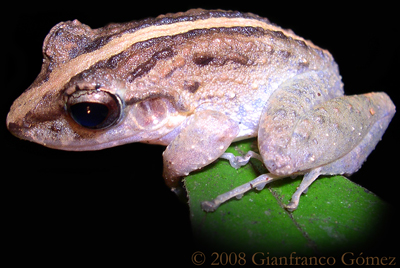
They are
medium sized frogs, and adults measure between
23 and 53 millimeters. As with most frogs,
females are much larger than males. Males are
very vocal and can be heard calling sporadically
throughout the night, much more frequently
during the rainy season.
Their advertising call has
been described as a series of "clacks",
resembling two small rocks being struck
against one another. Males will respond to
other calling males as well as to humans
imitators. This makes locating these frogs a
much easier task. It seems that males respond
to other calls with a much shorter and harsher
cackle, possibly a territorial call. Males
seem to be quite territorial and we have had
several irate frogs approach us frantically
when we call out to them.
|
|
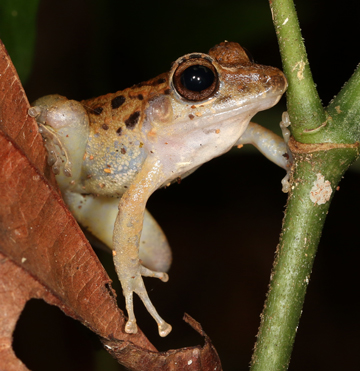 Coloration and
color patterns may be quite variable within
this species. Some individuals have a stripe
running down their back, some have spots,
while others have a solid color. Coloration
may range from gray to brown and anywhere in
between. Coloration and
color patterns may be quite variable within
this species. Some individuals have a stripe
running down their back, some have spots,
while others have a solid color. Coloration
may range from gray to brown and anywhere in
between.
This has led to much confusion
and many misidentifications of these frogs by
researchers throughout the years.
Even with all of these
variations, they do have a few distinguishing
characteristics. A pattern of yellow spots
overlaid on a dark background located on the
back of the thighs and a diffuse white line
running down the middle of their throat are
diagnostic. Their call is also diagnostic.
Since females don't call, though, this is only
useful in identifying males.
|
|
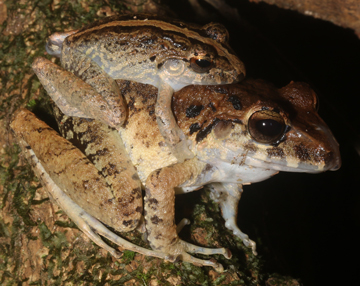 Despite being so
abundant, Common Rain Frogs have proven to be
something of an enigma for scientists. The
first recorded discovery of their nest dates
back to June 2, 1931. Dunn found a nest with
44 eggs laid on the ground, underneath leaf
litter. There was an adult frog, probably a
female, guarding the egg clutch. Despite being so
abundant, Common Rain Frogs have proven to be
something of an enigma for scientists. The
first recorded discovery of their nest dates
back to June 2, 1931. Dunn found a nest with
44 eggs laid on the ground, underneath leaf
litter. There was an adult frog, probably a
female, guarding the egg clutch.
Incredibly,
this was the only recorded egg clutch found by
scientists for over 70 years! During
these 7 decades researches pursued,
unsuccessfully, their quest for the common
rain frog's egg clutch. A thirteen month
study of the leaf litter carried out at La
Selva Biological Station failed to reveal any
nests.
|
|
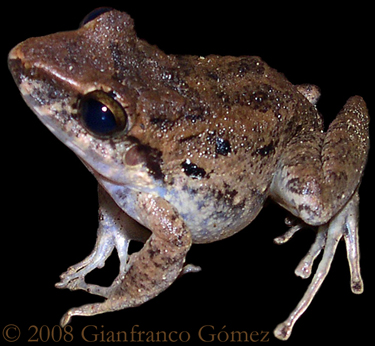 In 2002, 71
years after the first nest was discovered,
Mendoza found a second Common Rain Frog nest
on the ground with 85 eggs and a female frog
guarding them. The embryos in this species go
through direct development inside the egg.
They never have a free swimming tadpole stage
and tiny, fully formed frogs emerge from the
eggs. In 2002, 71
years after the first nest was discovered,
Mendoza found a second Common Rain Frog nest
on the ground with 85 eggs and a female frog
guarding them. The embryos in this species go
through direct development inside the egg.
They never have a free swimming tadpole stage
and tiny, fully formed frogs emerge from the
eggs.
Common
Rain Frogs are known to exist in humid zones
of Honduras, Nicaragua, Costa Rica, Panama,
and Colombia.
|
|
|
|
The Frog Files




     





|


 Alien
Earthlings
Alien
Earthlings  The Dark Side

