|
Discover
the hidden treasures of Drake Bay, Costa Rica with Tracie
"The Bug Lady"

Home
Tour
Basics
Meet
the Bug Lady
Tales
from the Edge
Media
Reservations
Links

Facts about Drake Bay, Costa Rica
Travel To
Drake Bay
Drake Bay
Area Map
Hotel
Information
Tips for Travelers
Tours
Recommended
Reading


|
|
|
White-lined
bats
Saccopteryx sp.
|
Greater
White-lined Bats - Saccopteryx bilineata
|
|
White-lined bats are some of
the most conspicuous bats you are likely to see
while visiting the Osa Peninsula. These clever
little bats are fond of using the overhangs of
houses, or ecolodges, as their roosts and have
learned to coexists with humans even in very
altered environments.
There are two species of
White-lined Bats in Costa Rica and they are
both very similar: the Greater White-Lined Bat
(Saccopteryx bilineata) and the Lesser
White-lined Bat (Saccopteryx leptura).
The Brazilian-long
Nosed Bat is the only other Costa Rican
bat with two white lines on its back, but it
is easily distinguished by its flecked,
grayish fur and very long nose.
White-lined Bats are quite
small, with adults normally measuring about 5
centimeters. They are also called Sac-winged
Bats because they have a sac shaped scent
gland on their wings, near the forearm.

Lesser White-lined Bat -
Saccopteryx
leptura
Lesser
White-lined Bats live in small colonies. Males
and females tend to form long lasting,
monogamous pairs. Male bats fill their sacs with
saliva, urine and other secretions. These
liquids ferment and provide the males with a
perfume which is unique to each male. Scientists
believe this scent helps female bats choose
their mate.
Greater White-lined Bats
normally live in small harems made up of one
male and up to eight females, but colonies of
up to fifty bats have been documented. These
large colonies are usually made up of several
coexisting harems. Females will frequently
switch to other harems while males normally
remain tied to their territories.
|
|
White-lined Bats are strict
insectivores. They begin foraging while it is
still light out and hunt through the night.
While foraging they fly at an average speed of
5.75 meters per second and eat mostly small
beetles and flies. Males normally defend a
foraging territory and each female in the
harem has her own foraging territory within
that space. 
During their breeding season,
harem males serenade each female as they
return from foraging. They will indulge in
long, complicated songs which are audible to
humans. As they sing, they will periodically
hover in front of the females and perfume them
with their scent.
The perfume, which is also
easily detected by humans, is released from
the scent sacs on their wings. This ritual may
take place several times throughout the day.
Rival males will also partake in long "scent
flights" with one another, specially when
their territory shares a common border.
Despite all of the singing,
displaying, and perfuming, copulation for the
Greater White-lined Bat only takes place
during a short period late in the rainy
season. Females give birth to their pups in
May, in sync with the return of the rains.
This pattern is different in the Lesser
White-lined Bat, and females may produce two
litters. In this case they will give birth in
May and in October or November.
|
|

Female Greater White-lined
Bat with her pup - Saccopteryx bilineata
The
newborn bats suckle for several months, although
they can usually fly on their own when they are
two weeks old. Females provide all the parental
care to the young bats. Each night, when females
go out and forage, they take their pups away
from the daytime roost to a secret hiding place
for them to pass the night safely. Each pup has
its own hiding spot. In the morning they
retrieve the pups and return with them to their
daytime roost.
In
August and September, when they are three to
four months old, the new generation of
White-lined Bats will leave the harem. Studies
have shown that females consistently leave the
area, while about half of the males will
attempt to establish their own harems nearby.
|
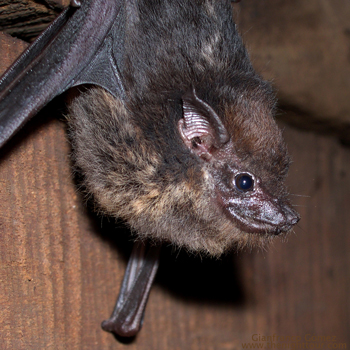
Greater White-lined Bat - Saccopteryx
bilineata
|
|
|
Mammal Files









|


 Alien
Earthlings
Alien
Earthlings  The Dark Side


