|
Discover
the hidden treasures of Drake Bay, Costa Rica with Tracie
"The Bug Lady"

Home
Tour
Basics
Meet
the Bug Lady
Tales
from the Edge
Media
Reservations
Links

Facts about Drake Bay, Costa Rica
Travel To
Drake Bay
Drake Bay
Area Map
Hotel
Information
Tips for Travelers
Tours
Recommended
Reading


|
|
| |
|

|
| Bradypus
variegatus |
|
Both
the Brown-throated Three-toed Sloth and
Hoffman's Two-toed Sloth have very strange
bathroom habits for animals considered canopy
species. Instead of dropping their waste from
the treetops, which monkeys seem more than happy
to do (throwing it on occasions), sloths make a
bizarre weekly pilgrimage down to the ground to
take care of business on "terra firma".
Upon arrival Three-toed
Sloths dig a hole with their stubby tail and
lay their urine and droppings in it.

They
may loose up to one third of their body weight
in urine and feces during one of these trips!
The hole is then covered up and the sloth makes
its journey back into the treetops. Two-toed
Sloths don't have a tail, so they just lay their
droppings on the ground and begin their ascend
to the treetops when they are finished.
Until
recently it was a mystery why they behave this
way, since it would seem that by descending to
defecate they are putting themselves at great
risk.
Researchers have found that
there is a very good reason they descend to the
ground to defecate.
It turns out that Sloth's fur
may be home to up to 100 moths and up to 1000
beetles! When Sloths descend to the ground to
defecate these insect make their way to the dung
and lay their eggs in it. Their larvae develops in
the dung and when they become adult insects they
fly up into the treetops and find another sloth.
The
Sloth Moth, Cryptoses choloepi, exists nowhere else in
nature except in association with Sloths and
scientists believe this relationship has been
ongoing for millions of years. Several Sloth
Moths are visible on the back of the Sloth in
photograph featured here.
A really close inspection of
the Sloth's fur will reveal many small grooves
which cover each one of the hairs on which algae
grows. The algae provides Sloths with some
camouflage, making their fur look green. It also
helps hide their scent from predators.
But the algae provides Sloths
with an even more important service. Researchers
have recently found that Sloths graze on their
algal gardens from which they obtain easily
digestible lipids and carbohydrates. It is
literally a nutritional supplement for the Sloth!!
It is a vitally important nutritional supplement
because Sloth's normally leafy diet is very
difficult to digest and may take up to 3 weeks to
pass from one end to the other.
The
algae thrives on the decaying bodies and the
feces of the insects along with oils from the
sloth's skin. Scientists estimate that the moths
also introduce inorganic nitrogen and phosphorus
(possibly from the Sloth feces in which they
develop as larvae) into the Sloth's fur which
helps foment the algal garden. This fecal matter
along with the dead insects and insect feces are
further broken down by over 80 different species
of fungi also present on the Sloth's fur, making
the nutrients more accessible to the algae. So,
the more insects the sloth has living in its
fur, the more algae the Sloth will have growing
on its hair which will in turn enhance the its
nutrition!!!
In essence, these very
different organisms are linked in a symbiotic
relationship which benefits them all. The Sloth
contributes by providing a home for them in its
fur and venturing down to the ground to lay a nice
big pile of dung on which the insects can lay
their eggs.
So as
not to attract to much attention, these trips
often take place under cover of the night. This
allows us night owls a rare close up view of an
animal normally seen high in the trees through
spotting scopes and binoculars.
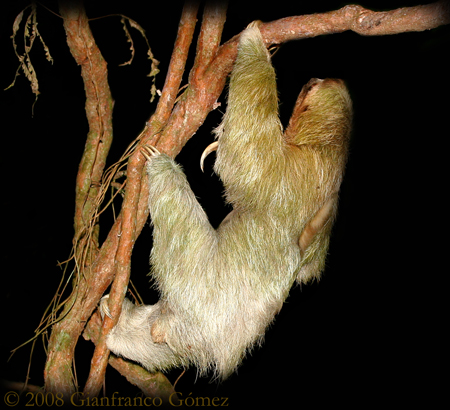
Every
so often on the Night Tour, we are fortunate
enough to cross paths with one of these canopy
dwellers at eye level and find ourselves face to
face with a sloth. These encounters are
wonderful experiences and immediately strike
wonder into every member of the group, guides
included.
Sloths,
especially Three-toed Sloths, emit a certain
tranquil vibe that is hard to match. Often, when
we cross paths on the trail, they don't seem to
mind our company too much and simply carry on
with whatever was occupying them before we
arrived. There is something very heartwarming
and reassuring in their sluggish stride and
gentle smile.
Like everything in nature,
Sloths are built to perfection for life in
their environment: the forest canopy. Their
hands and feet have evolved into hook like
appendages from which they hang from tree
limbs effortlessly. Their perceived laziness
is more aptly described as energy efficiency
at its finest. Because the Three-toed Sloth's
diet is made up almost entirely of leaves,
which contain hard to obtain calories, a
sloth's activity level is necessarily low.
|
|
Everything
about the sloth, even down to its hair, is
designed to minimize energy consumption. Its
thick fur provides insulation and prevents heat
dissipation. The Sloth's hair is parted along
their belly pointing downward, towards it's
back. This way, rain will more easily run off
its hair keeping the skin warm and dry.
Another
way Sloths conserve energy, which is quite
remarkable for a mammal, is by entering a
nightly hibernation. Instead of investing
valuable energy in maintaining a steady body
temperature, on cold nights Sloths allow their
body temperature to drop as much as twelve
degrees centigrade! Other mammals, including
humans, would find themselves fighting for their
lives with even a five degree drop in
temperature.
|
|

In
the morning, they make their way to the treetops
and sunbathe in order to raise their body
temperature to the levels required for them to
resume their activity.
Traditionally, this has
made Sloths an easy meal for one of their main
predators, the Harpy Eagle. These are the
world's heaviest eagles and females may stand
over a meter tall weighing up to 7.5
kilograms. An average Three-toed Sloth only
weighs about 4 kilos.
When
hunting, Harpies glide in or below the forest
canopy, making short flights through the
treetops, stopping to look and listen for prey.
Once they have located a target, including even
the most camouflaged sloth, there is little hope
for it.
Attacks
are swift and sudden and usually come from the
side or below. With talons as long as bear claws
and wrists as thick as those of an adult man,
the Harpy Eagle pounces on the helpless sloth
and rips it from the tree despite its strong
grip.
Research
at one Harpy Eagle nest site revealed that the
parent birds brought 26 sloths back to the nest
for their hatchlings to feed on during a 10
month period! Although Sloths make up a large
part of the Harpy Eagle's diet, other prey items
may also include monkeys, porcupines, opossums,
coatimundis, and other large mammals.
Despite popular claims regarding their
incredibly slow movements, Sloths can certainly
move when they need to. We have often watched
Three-toed Sloths move all the way across our
garden, if not swiftly certainly steadily, and
most individuals we encounter on The Night Tour
are usually nowhere to be seen within a few
minutes. Two-toed Sloths can be surprisingly
quick, much more so than Three-toed Sloths.
|
|
One night, during a Night
Tour, we saw two female Sloths fighting for
feeding rights in a Cecropia tree. What a scene! One
female would swing her arm back behind her
head, in a futile attempt to gain momentum,
and then hurl it towards her rival. Meanwhile,
the other female would begin to lean backwards
way ahead of time, anticipating the strike.
They went on like this for several minutes
until we finally left them to sort themselves
out in private.
It
was a little bizarre, resembling the scene
in "The Matrix" where Keanu Reeves is
dodging bullets in slow-motion.

After
the tour, as we were heading home, we saw one of
the females retreating down the trunk of the
tree. It was then that we noticed she had been
cradling her baby throughout the whole ordeal.
Three-toed Sloths are active an average of 10
hours per day, about three more hours than their
Two-toed counterparts. This activity level is
not uncommon for animals that only need to feed
sporadically. They get all the moisture they
require from their leafy meals and have no need
to seek out drinking water.
Still,
Sloths cling to their reputation as lazy and
static creatures. Adrian Forsyth's captivating
book Portraits of
the Rainforest tells
of a myth by The Bororo Tribe of South America
that may help explain, and perhaps excuse,
their laid back demeanor.
"Long
ago, the sloth was not easygoing. He moved
rapidly through the forest and had a nasty,
greedy temperament. One day, the Almighty
decided to descend to Earth. He waited four
weeks until the hole in the sky known as the
moon was fully open, and then He climbed down on
a liana.
On His
arrival, He went to drink at a water hole. A
group of animals - a tapir, a hare, a jaguar, an
anteater and others - all stepped aside so that
He could drink first. All but the sloth. The
sloth pushed ahead and drank greedily and at
great length. This, of course, angered the
Almighty One, and He announced to the sloth that
in punishment, He would cast a spell.
The
terrified sloth expected death. But the Almighty
just breathed on him, snuffing out forever his
greed and thirst. With great relief, the sloth
smiled, and since then, he has never had another
drink and has been as easygoing as they get."
|
|
|
|
Mammal Files








|


 Alien
Earthlings
Alien
Earthlings  The Dark Side
